Environment Agency Inspection Checklist for Waste Carriers
An Environment Agency (EA) inspection can happen any time: on the roadside, at your depot, or at a customer site. The best way to handle one is to be ready before it happens. This checklist covers the documents you need, what inspectors look for, and what happens if you fall short. Carriers using digital consignment notes can pull up any record in seconds.
What to expect from an EA inspection
EA inspections for waste carriers usually come in three forms:
- Roadside stops: Officers stop vehicles carrying waste and check documentation on the spot. These are often part of multi-agency operations with the police and DVSA. You will be asked for your waste carrier registration, consignment notes or transfer notes for the load you are carrying, and your vehicle documentation.
- Site visits: An inspector visits your depot or office to review your record-keeping, duty of care procedures, and overall compliance. These can be announced or unannounced.
- Desk-based reviews: The EA requests documents by post or email, usually consignment notes for specific date ranges or waste streams. You are expected to respond promptly, usually within 14 days.
Documents you need ready
Keep these documents handy at all times. For roadside stops, drivers need them in the vehicle. For site visits and desk reviews, your office records need to be tidy and easy to pull up.
To the EA, a record you cannot produce is a record that does not exist. Inspectors will not wait while you dig through boxes. If you cannot show a document quickly, expect a compliance notice.
Waste carrier registration
Your waste carrier registration certificate (upper or lower tier, as applicable) must be current and available.
Keep the original accessible for site visits and desk-based reviews.
Upper tier registrations last three years. You should know these without having to look them up.
Check the EA public register periodically to confirm your registration is showing as active.
Consignment notes (last 3 years)
Under Regulation 49 of the Hazardous Waste (England and Wales) Regulations 2005, you must retain consignment notes for every hazardous waste movement for a minimum of three years from the date of transfer. Inspectors will ask for specific notes, often by date, customer, or waste type, and expect you to produce them quickly.
Every note should be fully completed. A note with a blank Part E is an incomplete note and a compliance failure.
If you are using paper, ensure copies are not faded or damaged.
Organise records so you can search by date range, customer name, or EWC code.
If any notes are incomplete (e.g., Part E not returned by the consignee), follow up and document your efforts to obtain the missing information.
Duty of care transfer notes
For non-hazardous waste, you need waste transfer notes (also called duty of care notes) under Section 34 of the Environmental Protection Act 1990. Keep these for at least two years. Many carriers keep them for three, to match their hazardous waste records.
Must describe the waste, identify the parties involved, and confirm the waste carrier registration.
Transfer notes can cover a series of regular movements (a "season ticket" arrangement) rather than individual loads, provided the waste description and parties remain the same.
Waste management licences and permits
If your business receives, stores, or treats waste, rather than only transporting it, you need the relevant environmental permits or exemptions. Even if you are solely a carrier, you should:
Verify that the facilities you deliver to hold valid permits for the waste types you are transporting.
Keep a record of the permit numbers for your regular receiving sites.
Delivering waste to an unpermitted facility creates liability for the carrier as well as the operator.
Vehicle inspection records
Vehicles used to carry waste must be fit for purpose and maintained to prevent spillage or leakage during transport.
Particularly for containment integrity (sealed beds, functioning tail lifts, secure load restraints).
Evidence of spill kits and emergency equipment carried in vehicles that transport hazardous waste.
Driver training records
Drivers who handle hazardous waste should be properly trained. There is no single must-have qualification, but the EA expects you to show that your drivers understand:
Keep training records with dates, topics covered, and the name of the trainer. Refresher training should be done at least annually. Inspectors look for evidence of regular training, not only one-off inductions.
Common triggers for inspection
Routine inspections happen as part of the EA's normal programme. Some events make one more likely:
- Complaints: A complaint from a member of the public or another business about waste being handled improperly, fly-tipping, or environmental nuisance linked to your operations.
- Incidents: A spill, accident, or environmental pollution event involving your vehicles or waste. The EA will investigate the circumstances and review your compliance record.
- Intelligence: Information from other agencies (police, local authority, HMRC) that suggests waste is being handled illegally.
- Permit breaches at receiving sites: If a facility you deliver to has compliance issues, the EA may trace waste back through the chain and inspect carriers who use that site.
- Previous non-compliance: If you have received warnings or enforcement action in the past, you are more likely to be re-inspected to check that issues have been resolved.
What inspectors look for
EA inspectors are trained to spot both paperwork gaps and real-world risks. During a visit, they will usually:
- Check your waste carrier registration is current and matches the details on your vehicles and documents.
- Request specific consignment notes and assess whether they are complete, accurate, and easy to retrieve.
- Review EWC codes and hazard codes on a sample of notes to check they are correct for the waste described.
- Verify that the receiving facilities listed on your consignment notes hold valid permits for the waste types involved.
- Inspect vehicles for containment, labelling, and the presence of emergency equipment.
- Ask drivers about their understanding of the waste they are carrying and the procedures they follow.
- Look at your overall record-keeping system and whether it allows for systematic compliance rather than relying on individual memory.
Penalties for non-compliance
What happens if you fail an EA inspection depends on how serious the breach is:
- Advisory letters and warnings: For minor, first-time administrative failings. These go on your compliance record and increase the likelihood of future inspections.
- Compliance notices: A formal notice requiring you to take specific corrective action within a set timeframe. Failure to comply with a notice is itself an offence.
- Fixed penalty notices: For certain offences, the EA can issue on-the-spot fines.
- Prosecution: For serious or repeated offences. Convictions for waste offences can carry unlimited fines in the Crown Court, and in the most serious cases, imprisonment for up to five years.
- Registration revocation: The EA can revoke your waste carrier registration, which means you can no longer legally transport waste. For a waste carrier business, this is effectively a closure order.
Convictions for waste offences can carry unlimited fines and up to five years' imprisonment. The EA can also revoke your waste carrier registration entirely, which can effectively close your business.
How to stay inspection-ready
Carriers who breeze through inspections are not doing anything clever. They have three things in common: their records are complete, organised, and easy to reach. The system you use matters less than keeping it up, week in, week out.
That said, digital record-keeping is easier to keep on top of than paper. It does not rely on drivers remembering to hand in notes, office staff filing them in the right place, or anyone scanning and backing up paper. Records are made, stored, and kept all in one place.
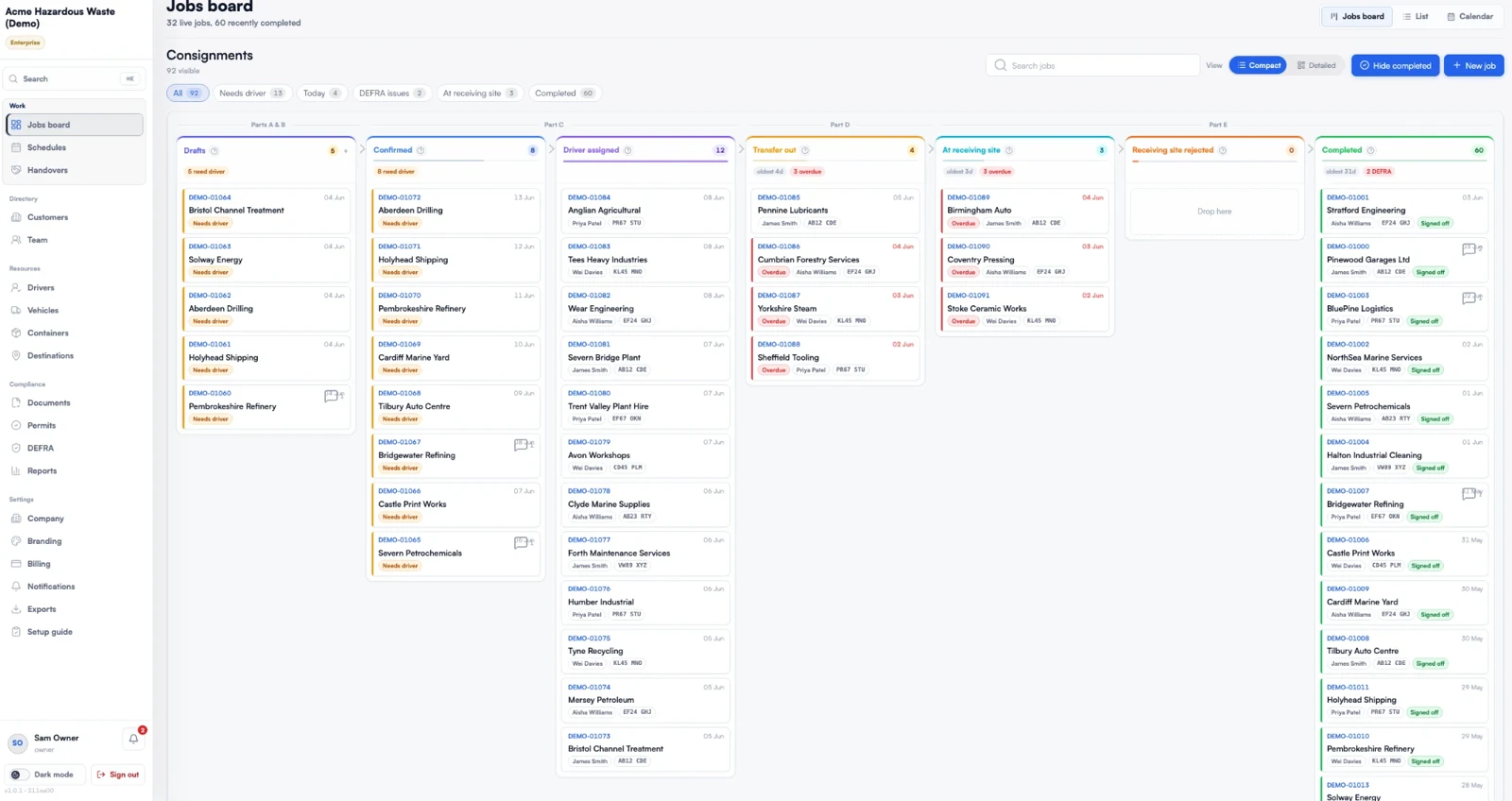
Consigns keeps every consignment note searchable and on hand for the full period the law requires. When the EA asks for a note from two years ago, you search by date, customer, EWC code, or driver and find it fast. See pricing.