7 Common Mistakes Waste Carriers Make (And How to Avoid Them)
Waste carrier compliance is not optional. The Environment Agency inspects carriers, and the penalties run from warning letters to unlimited fines and criminal charges. The annoying part: most enforcement comes from simple admin slip-ups, not from anyone cutting corners on purpose.
Here are seven common mistakes waste carriers make, and how to avoid each one. Most of them disappear when you swap paper for consignment note software.
Five of the seven mistakes below are really record-keeping problems. They happen because paper gets lost, fields get missed, and filing falls apart under the day-to-day load.
Not completing all five parts of the consignment note
A hazardous waste consignment note (HWCN01) has five parts, each completed by a different party at a different stage of the waste journey. In practice, Part E (the consignee's section) is the one most often left blank. The waste arrives at the receiving facility, but the completed note never makes it back to the carrier.
Why it matters: Under the Hazardous Waste (England and Wales) Regulations 2005, carriers must hold a fully completed consignment note for every movement. A note with a blank Part E is an incomplete note, and an incomplete note is a compliance failure, even if the waste was handled properly.
How to avoid it: Build a process for chasing incomplete notes. Set a reminder for 14 days after each collection. If Part E has not been returned by then, follow up with the receiving site. A digital system can track completion status and flag outstanding notes.
Using the wrong EWC codes
The European Waste Catalogue (EWC) has hundreds of codes. Picking the right one means knowing both the waste type and the process that made it. A common slip is grabbing a vague catch-all code when a more exact one exists, or copying a code from an old note without checking it still fits.
Why it matters: The EWC code determines how the waste must be handled, treated, and disposed of. An incorrect code can mean the waste is sent to a facility that is not permitted to accept it, which creates liability for the carrier as well as the consignor and consignee. During inspections, the EA cross-references EWC codes against permits.
How to avoid it: Use our free EWC code checker to find the right code fast, and the EA's waste classification technical guidance (WM3) to verify it. Keep a reference list of EWC codes for the waste streams you regularly handle, and review it annually. If a customer's waste description does not clearly map to a code, ask for a waste analysis before accepting the collection.
Missing or incorrect hazard codes
Hazard codes (the HP codes under the CLP Regulation framework) describe the hazardous properties of the waste, such as flammable, corrosive, toxic, or ecotoxic. Waste can have multiple hazardous properties, and all of them must be listed on the consignment note.
Why it matters: Hazard codes affect transport requirements, PPE requirements, and the type of facility the waste can be sent to. Missing a hazard code creates a record problem and a genuine safety risk. If a spill occurs during transport and the hazard codes on the consignment note are incomplete, the emergency response may be inadequate.
How to avoid it: Cross-reference the chemical composition of the waste against the full list of HP codes (HP1 through HP16). Do not assume a waste stream only has one hazardous property. When in doubt, request a safety data sheet (SDS) from the waste producer and use it to identify all applicable codes.
Keep a reference list of EWC codes and HP hazard codes for your most common waste streams. Review it annually and update it whenever you take on a new waste type. This single step prevents the majority of classification errors.
Not retaining records for 3 years
Regulation 49 of the Hazardous Waste (England and Wales) Regulations 2005 requires all parties involved in a hazardous waste movement to retain their copy of the consignment note for a minimum of three years from the date of transfer. This is a legal obligation.
Why it matters: The Environment Agency can request records going back three years at any time. If you cannot produce a consignment note when asked, it is treated as a compliance failure regardless of whether the waste was actually handled correctly. "We had it but we lost it" is not a defence.
How to avoid it: Set up a clear filing system, whether physical or digital, and make sure every note has a home within 48 hours of the collection. If you use paper, scan and back it up. If you use a digital system, make sure it keeps records for the full statutory period.
Carrier registration expired or not displayed
Every business that transports controlled waste must be registered as a waste carrier with the Environment Agency. Upper tier registrations last three years and must be renewed before they expire. Carrying waste with an expired registration is a criminal offence under the Control of Pollution (Amendment) Act 1989.
Why it matters: This is one of the first things an EA inspector checks during a roadside stop or site visit. An expired registration, even by a single day, means you are carrying waste illegally. The penalties include a fine of up to £5,000 in a magistrates' court, or an unlimited fine in the Crown Court, plus the potential loss of your registration.
How to avoid it: Set a calendar reminder 90 days before your registration expires and begin the renewal process immediately. Keep a copy of your registration certificate in every vehicle and in the office. Check the EA's public register to confirm your registration status is showing as active.
No duty of care documentation
The duty of care under Section 34 of the Environmental Protection Act 1990 requires anyone who produces, imports, carries, keeps, treats, or disposes of waste to take all reasonable steps to ensure it is managed properly. For carriers, this means having a written description of the waste (a waste transfer note or consignment note) for every load.
Why it matters: Duty of care documentation is separate from, and in addition to, hazardous waste consignment notes. For non-hazardous waste, you need a waste transfer note. For hazardous waste, the consignment note serves as your duty of care record. If you carry both types of waste, you need both types of documentation. A gap in your duty of care records is an offence in its own right, carrying a maximum fine of £5,000 on summary conviction.
How to avoid it: Make sure every load that leaves your vehicle has the right document. Train your drivers to understand that no note means no collection, without exception. Run a monthly check for gaps.
Paper records that cannot be found during inspection
This is perhaps the most common practical problem. The consignment notes were completed correctly. The records exist somewhere. But when the Environment Agency turns up for an inspection and asks for a specific note from 18 months ago, nobody can find it. Filing cabinets are full, notes are in the wrong folder, or the driver who did the collection left the company and took his notebook with him.
Why it matters: From the EA's perspective, a record you cannot produce is a record that does not exist. Inspectors will not wait while your office searches through boxes. If you cannot produce the requested documents promptly, you will likely receive a compliance notice, and it sets a poor tone for the rest of the inspection.
How to avoid it: Move to a system where records are searchable. Whether that is a well-organised digital filing system or a purpose-built waste management platform, the key requirement is the same: when someone asks for a specific consignment note, you should be able to find it in seconds, not hours.
The digital advantage
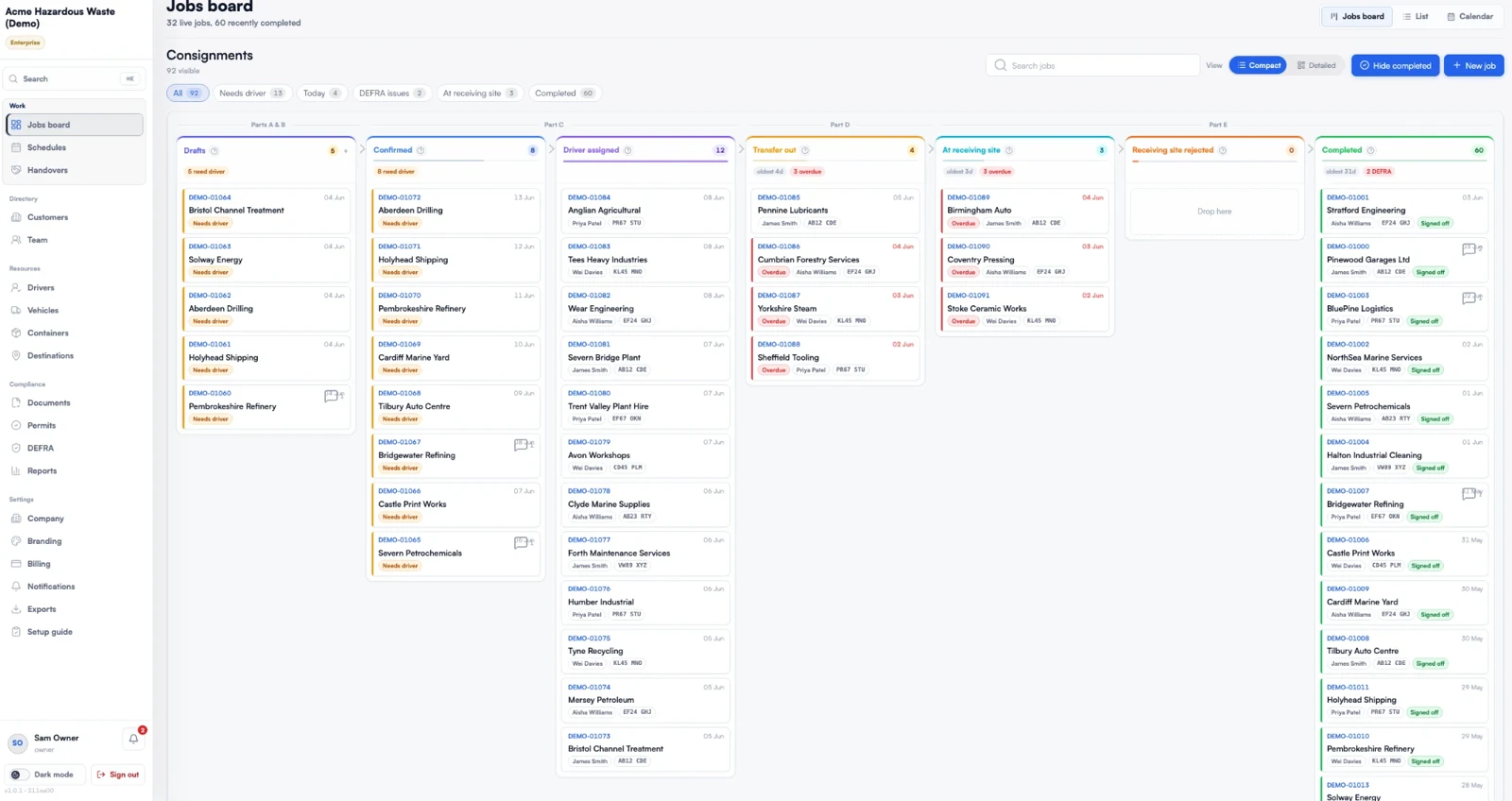
Five of the seven mistakes above are record-keeping problems. They happen because paper gets lost, fields get missed, and filing falls apart under the day-to-day load. Digital consignment note systems help by making the required fields clear, storing records for the full period, and letting you search notes by date, customer, or waste type.
Consigns is built for UK hazardous waste carriers. It handles consignment notes, driver job flow, signatures, and safe record storage, so your team spends less time wrangling paper. See pricing.